Periodontal Disease
Periodontal (perry-o-DON-tal) disease is an infection that affects the tissues and bone
that support your teeth. It is also called gum disease.
Checking for Periodontal Disease
1. Probing
When checking for periodontal disease, your dentist or hygienist uses an instrument
called a periodontal probe to gently measure the depth of the pockets around each of
your teeth. When your teeth are healthy, the pocket depth should be 3 millimeters
(mm) or less.
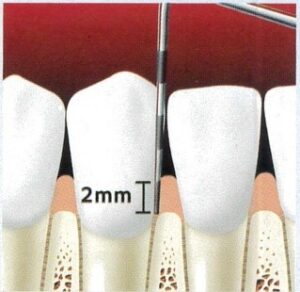
periodontal probe of healthy gums. (Pocket depth >= 3mm)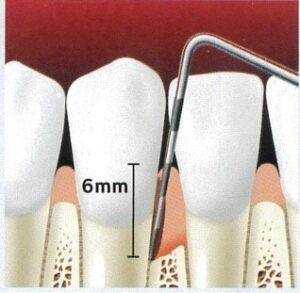
Periodontal probe showing a pocket forming between the tooth root and the gum.
Usually, the more severe the disease, the deeper the pocket. This means more
advanced loss of bone attachment, allowing the bacteria to have more room to grow
and cause serious damage to your gums and bone, loosening your teeth.
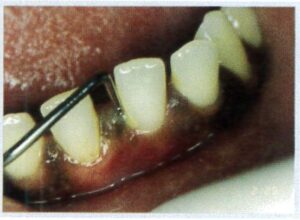
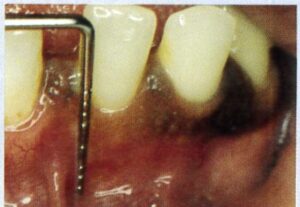
This patient has pockets of 8mm, which is a sign of gum disease. Signs of gum disease, such as deep pockets, can be difficult to notice on your own.
Scaling and root planing is not the same as a regular cleaning!
This treatment is a deeper cleaning that focuses on getting your infection
and inflammation under control. Be sure to follow all of the
recommendations of your dentist, or your gum disease could get worse.
2. Dental X-rays
Dental x-rays can check for the amount of bone supporting your teeth. If low bone
levels are spotted, it could be a sign of damage from gum disease.
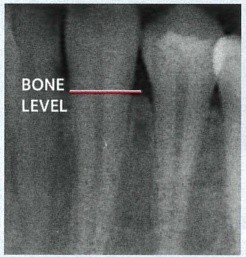
X-ray showing supporting bone.
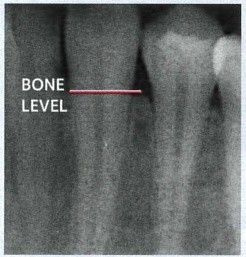
X-ray showing bone loss.
Treating Periodontal Disease
Your treatment will depend on factors such as your personal health history and the
stage of your gum disease.
Your dentist may also refer you to a periodontist — a dentist who specializes in the
treatment of gum disease. A periodontist is well versed in the surgical treatment of gum
disease.
Professional Cleaning
If the gum disease is caught early enough (while it is still gingivitis), you may simply
need a professional cleaning and improved home hygiene. Your dental team can
also give you advice for improving your daily oral hygiene.
Scaling and Root Planing
A professional cleaning is not enough if your gum disease is severe. Usually a special
deep cleaning called scaling (SKAY-ling) and root planing (PLAY-ning) is needed.
Scaling:
During scaling, your dentist or hygienist carefully removes plaque and tartar down to the
bottom of each periodontal pocket.
Root Planing;
The next step is root planing, which is cleaning and smoothing your tooth’s root
surfaces, e.g. the root surfaces are “planed”. Smoothing (planing) the surfaces helps
your gums heal and reattach to the tooth, shrinking the pocket depth.
Scaling and root planing may take more than one visit depending on the amount of
treatment you need.
At follow-up visits, your dentist or hygienist will measure the pocket depths to see if
scaling and root planing has been successful. If the pockets have deepened and the
supporting bone is lost, more treatment may be necessary.
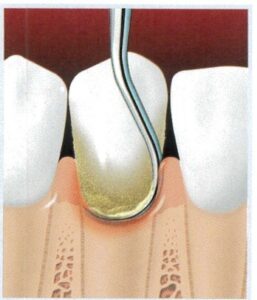
Scaling removes plaque and tartar from below the gumline.
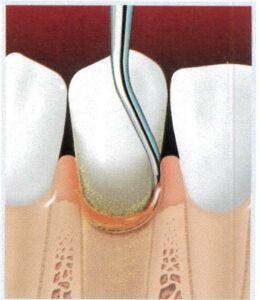
Rooth planing smoothes the tooth root and helps the gums
reattach to the tooth
Periodontal Surgery
If the pockets do not heal enough after scaling and root planing, periodontal
surgery may be needed. Surgery allows your periodontist or dentist to remove tartar
and plaque from hard-to-reach areas.
After surgery, your gums are stitched into place to tightly hug your teeth. Surgery can
reduce pocket depth and make it easier to keep your teeth clean.
If bone has been damaged by gum disease, you may need surgery to rebuild or
reshape the bone.
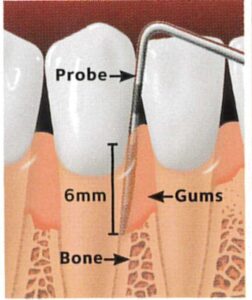
Probe shows pockets due to periodontal disease. Gum are inflamed and bone loss has
occurred.
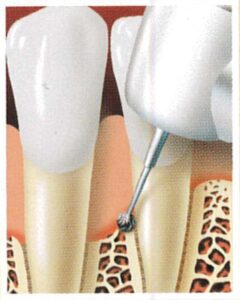
The bone is reshaped and any remaining tartar is removed.
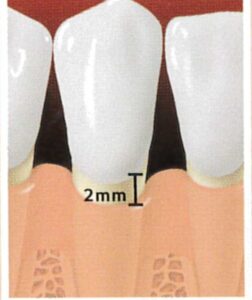
Healed site after periodontal surgery
Keeping Gums Healthy After Treatment
• Your dentist may suggest more frequent checkups and deep cleanings to keep your
gum disease under control.
• Keep plaque under control by brushing 2 times daily with a fluoride toothpaste for 2
minutes each time. Clean between your teeth daily using floss or another between-the-
teeth cleaner.
• Your dentist may suggest or prescribe medicines to help control infection and pain or
to help your gums heal.
• If you use tobacco in any form, ask your dentist or physician for information about how
to quit.
• If you have a disease that may be linked to gum disease, such as diabetes, work with
your physician to help manage it.
You don’t have to lose teeth to periodontal disease.
Brush, clean between your teeth, eat a healthy diet and schedule regular dental visits
for a lifetime of healthy smiles.
